Sexuality & Language
Why is language so important?
Sexuality and language are closely intertwined. The way, when, and with whom we talk about sexuality influences how we perceive it
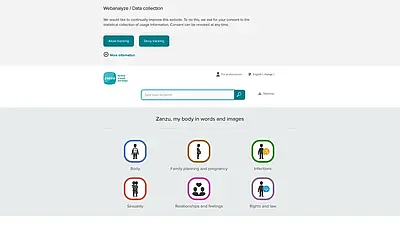
Multilingual, easy-to-understand information on sexual health
Reducing language barriers to counseling
-
-
Zanzu - My body in words and images
Zanzu website -
-
Zanzu - My body in words and images
Mumu, Yoni, Vulva
How do we speak and when?
Even when we talk about the same things, we often use different words to describe them. Our choice of words differs depending on how old we are, who we are talking to, and what situation we are in—or what impression we want to make.
Our choice of words is influenced by the society in which we live and grew up. Gender norms and power structures that we have learned in society are often reflected in our choice of words. This means that language conveys certain ideas about gender. This often happens unnoticed and unintentionally. For us, it is important to use language that encompasses as many people as possible, i.e., language that is inclusive.
So which one is it: mumu, yoni, or vulva? You can find out more about this under the topic of sex organs.
Styles of speech
| Style of speech | Characteristics | Examples |
|---|---|---|
| Technical language | Subject- or profession-specific (e.g., medical), neutral, impersonal | vulva, vagina, labia, erection |
| Everyday speech | common, personal | breast, dick, hard-on |
| Vulgar language | sometimes derogatory, sometimes suggestive | fucking, pussy, prick |
| Standard language | socially accepted, factual, generally understandable | sexual intercourse, penis |
| Baby talk | belittling, often inaccurate | pee-pee, mumu |
Questioning taboos
In our society, taboos are commonly equated with forbidden things, even if they are not quite the same. They often convey social rules of behavior. They dictate that something should not be done, said, thought, or felt.
Breaking taboos
Terms such as “Schambereich” (German for “pubic area”) associate genitals with shame. Other metaphors also make sex a taboo subject. It is better to use neutral terms such as “vulva” or “penis.” Of course, the most important thing is to feel comfortable with the words you use and not to put other people in an awkward situation. But a little practice can go a long way. The long-term goal is to establish a language that does not stigmatize sexuality, but describes it openly and without judgment.
Conscious language choices can help create a respectful and inclusive atmosphere for conversation—in private, educational, and professional contexts.
Language and its meaning are constantly changing, and even supposedly neutral terms can hurt other people or change in meaning (see cycle). That is why we refer to “more neutral” alternatives here, to make it clear that our language is not always perfect either.
| Term, German (English) | Criticism of the term | More neutral alternative |
|---|---|---|
| Schamlippe (labia) | Connects parts of the genitals with the word shame ("Scham" in German) | Vulvalippen (vulva lips) |
| Schambereich (pubic area) | Connects the genitals with the word shame ("Scham" in German) | Genitalbereich (genital area) |
| Dirty Talk | Judges talking during sex as “dirty” | Sexy Talk |
| Jungfernhäutchen (maidenhead) | The term is cis-normative in that it connotes the mucosal folds as female and as part of the “female” sex. This is because in the 15th century, it was assumed that the supposed membrane was proof of a woman's virginity. This is incorrect. The word “hymen” is anatomically inaccurate: it is not a closed layer of skin, but rather folds of mucous membrane. | Schleimhautfalten (mucosal folds), Vaginale Korona (vaginal corona or crown), Schleimhautkranz (mucosal rim), Schleimhautsaum (mucous membrane margin) |
| Scheide (vagina) | The term is metaphorically based on the “sword sheath” and thus reduces the organ to the possibility of penetration by a penis. Furthermore, it is heteronormative in that it refers to heterosexual sex. | Vagina |
| Hymen | Hymen is Greek for membrane or skin. This term is misleading because it refers to the myth of the “maidenhead.” | Schleimhautfalten (mucosal folds), Vaginale Korona (vaginal corona or crown), Schleimhautkranz (mucosal rim), Schleimhautsaum (mucous membrane margin) |
When, how, and with whom should you talk about sexuality?
Over the course of your life, you will encounter the topic of sex in various ways: in conversations with sexual partners, with friends, with people in your care, such as children and adolescents, as well as with doctors, or in your everyday work with clients and patients. It is therefore worthwhile to reflect on your own language, pay attention to the other person's reactions, and adapt your language to the situation.
Here is an overview of counseling centers and contact persons who work with different target groups and offer advice and a space to talk about sex.
Talking to partners about sex
Open conversations with sexual partners help to clearly communicate needs, boundaries, and desires.
Tips for the conversation:
- Choose the right moment: plan a few minutes for a conversation before sex—e.g., about contraception, desires, or taboos.
- Normalize talking about sexuality. Needs can change over time. This gives you a good basis for continuing to communicate with each other.
- If it feels right for you, start with something that has already felt good with the other person. This way, you start off by showing appreciation for one another.
- Maybe you want to talk to your sex partner about a fantasy without wanting to turn it into reality right away. Talk about whether it's a fantasy, a desire, or something in between.
Phrases to get the conversation started:
I thought it was really hot kissing you yesterday. I'd love to do more today. What would you like to do?
I've noticed that my needs when it comes to sex have changed.
Before we jump into bed, what do you need so you feel safe having sex?
Before we get started, I'd like to discuss how/whether we want to use contraception.
Talking to friends about sex
Sex influences well-being – talking helps to put experiences into context, clear up uncertainties, and gain new perspectives. Even without a sexual relationship, conversations with people you can trust can be beneficial.
Questions for self-reflection – also as a basis for discussion:
- What does sex actually mean to me?
- What arouses my desire – what doesn't?
- How does sex affect my well-being?
- What fantasies do I have, which ones would I like to live out and which ones would I rather not?
Starting the conversation:
I'm not very happy with my sex life at the moment and I'd like to talk to you about it—is that okay?
I've realized that there's something about sex that I don't like at all. Is it like that for you, too?
Talking to children about sex
Talk about sex and sexuality in a way that is age-appropriate, honest, and inclusive.
Children are curious, including about sexuality. They discover their own bodies at an early age and ask questions. Through their language and behavior, adults influence how openly or self-consciously children approach the topic of sex. Talking about the body and sexuality in a respectful way promotes a positive body image and healthy sexual development.
What matters:
- Talk in an age-appropriate, honest, and shame-free manner
- Use everyday moments to talk about the body, feelings, boundaries, and privacy
- Use child-friendly language
- Avoid experience-based descriptions of your own sexuality
- Ask for clarification of questions to understand the real reason behind them
- React calmly, even if children use unfamiliar words, and explain alternatives without judging
- Reflect on your own attitude toward sexuality
Examples of answers to the question “What is sex?”
What not to say: Sex is when a man and a woman love each other and want to conceive a child.
- Too heteronormative, excludes queer people
- Links sex to love and procreation
- Excludes sexual diversity
- Avoid abstract words such as “conceive.”
People have sex when they are attracted to each other and want to be close. Then they may kiss or pet each other or touch each other in places that feel good.
To sum it up: Sex can be explained in a way that's appropriate for kids, without clichés, with openness and respect.
Talking to teens about sex
Communicate respectfully and honestly at eye level.
Young people go through many first experiences
- First menstruation
- First ejaculation
- First love or sexual encounters
These topics should be addressed without shame or taboos, calmly, openly and as relaxed as possible. This creates trust, so young people are more likely to ask questions themselves.
Important: The teen should pick who they talk to about sex, not have that person assigned to them.
Take linguistic challenges seriously.
Young people often use sexualized and provocative language as an expression of self-discovery, differentiation, or insecurity.
What matters is:
- Not every choice of expression is meant to be hurtful. Often, it is simply a lack of vocabulary.
- If young people sense insecurity or shame in adults, they often adopt these feelings themselves.
- If derogatory language such as “bitch” is used without reflection, it can become normal, even if it is sometimes meant ironically or positively.
Adults should set a good example here:
- No unnatural use of youth language
- Find common terms without lecturing
- When language is hurtful, clearly explain why it is problematic and suggest alternatives
Conversation starters:
I remember that we used to have a lot of questions about sex, but often didn't know who to talk to about it. How is it for you and your friends?
Have you had sex education classes at school yet? What was that like, and are there still things that are bothering you?
If you ever have any questions about sex, your body, or love, you can talk to me anytime, or I can help you find someone else to talk to.
There is a lot of information about sex on social media and in TV shows, but not all of it is accurate. Have you ever noticed anything you were unsure about?
Time for Reflection
How was sexuality discussed with you as a teenager?
What would you have needed to have a good education before your first sexual experiences?
Talking to adults and older people about sex
Sexuality does not end when you get older, and talking about it remains important.
Sexuality continues to change physically, emotionally, and socially in adulthood and old age. Nevertheless, older people are often denied their sexuality or it is treated as taboo.
Typical topics of conversation may include:
- Being confronted with issues such as contraception and STIs for the first time after a breakup
- False belief: using protection is unnecessary after menopause
- Moving into a nursing home and thus a new living situation and changes in privacy
- Physical illnesses, medications, or hormonal changes affect desire and sexual function
- Living alone due to the loss of a partner and thus new questions about closeness, intimacy, and sexuality
I read that sexually transmitted infections are on the rise again, especially among older people. Would you like to take a look together at what we should be aware of?
You are meeting lots of new people right now. Have you thought about how you want to talk to new partners about protection?
How is sexuality actually handled in your nursing home? Are there private rooms and how openly is it discussed?
Time for reflection – questions for yourself
- Have you ever talked to your (grand)parents about sexuality or contraception?
- What issues or concerns might they have?
- If you were to break up after a long relationship, who would you talk to about sexuality?
Talking about sex with healthcare professionals
Address concerns and needs openly & assertively
It shouldn't be a problem, but unfortunately it often is -- doctors, nurses, psychotherapists, addiction counselors, and many others do not discuss sexuality with their clients. We are trying to change that! But until then, we want to offer a few tips on how clients can start the conversation about sex themselves.
Survey: How often has a doctor talked to you about your sex life? —> Never – Sometimes – Often – Always
Tips for starting a conversation about sexuality with healthcare professionals:
I currently have several partners and am unsure if there is anything I should be aware of, for example, regarding contraception and STIs.
I am not quite sure how to bring it up, but I am unhappy with my sex life right now.
I feel that the medication is affecting my libido. Are there any alternatives?
Do you have any tips for where I can get advice and counseling on sexual health?
Men, in general, are less likely to take advantage of healthcare services and experience gaps in care. Preventive checkups are very important for sexual health for everyone. Learn more in this video:
Talking about sex as a healthcare professional
Communicate effectively, with sensitivity and professionalism
Why discuss sexuality?
Sexuality affects all areas of life. Nevertheless, the topic is often neglected in many training programs, particularly in medical, psychological, or social professions. As a result, professionals often feel uncertain, rarely discuss sexuality, or use inappropriate language.
Reducing uncertainty – finding the right language
Tips
- Use neutral language and adapt it sensitively as the conversation progresses
- Create space for clients to choose their own terminology
- Avoid assumptions about identity, orientation, or relationship types
- Talk about sexuality even if it is not actively brought up
Approach sexual history taking in a professional and confidential manner
It has long been standard practice in medicine and therapy, and it can also help in social and educational settings to understand clients holistically.
Goals
- Create an environment of trust
- Address topics such as STIs, libido, contraception, or relationships
- Encourage people to come back later
What can be asked, depending on the setting and relevance:
- Medical history: STIs, pain, itching
- Reasons for coming in/symptoms
- Biographical background/learning history: social background, psychosexual development
- Sexual orientation and identity
- Relationships: committed, casual, anonymous, online, monogamous, polyamorous, open, closed
- Sexual practices: oral sex, vaginal and anal intercourse, chemsex
- Contraception & prevention: condoms, vaccination status (HPV, hepatitis), STI tests
- Substance use: e.g., cannabis, amphetamines, slamming
Conversation starters:
How satisfied are you with your sexuality at the moment?
What method of contraception are you currently using? Would you like advice on this?
When was your last STI test? Do you have any questions about this?
Do you feel that your diagnosis is affecting your relationship and/or your sexuality?
Who to ask? How to ask?
- Sexuality can be an issue for all age groups, from pediatricians to geriatric care
- Use neutral language to start with, then adjust if necessary, e.g., once pronouns or sexual orientations have been clarified
- Don't out people or pressure them, but give them space to disclose information for themselves
- Ask about pronouns, sex organs, and sexual orientation sensitively, with respect and candor
Multilingual, easy-to-understand information on sexual health
Reducing language barriers to healthcare
- Zanzu - My body in words and images
Zanzu website
- Zanzu - My body in words and images
Talking about sex in digital spaces
Sexuality on social media
- Strengthen autonomy: Everyone has the right to decide whether, how, and with whom they talk about sexuality or share content. The same rules that apply to direct communication also apply online.
- Consider the public nature of social media. Content shared on social media is rarely truly private. Screenshots, forwarding, or unnoticed recording can lead to a loss of control.
- Respectful language: The same rule applies online: sexualized language must not cause harm. Discrimination, body shaming, or sharing sensitive content without consent are forms of violence. You can find more information on the topic of sexualized violence here.
- Know the community guidelines: many platforms have rules about sharing intimate or sexualized content. It is worth knowing these for your own protection.
What does sexting mean?
Sexting means voluntarily and consensually exchanging with sexually explicit messages, images, or videos. This can be exciting and part of relationships or sexual self-determination. At the same time, sexting carries risks, such as unwanted dissemination of content or pressure from others.
Safer sexting: Tips
- Clarify consent: Sexting should only take place if everyone involved really wants to do it. Pressure or persuasion makes sexting abusive.
- Find your own language! Sexting can take many different forms. Find a way that feels right for you and the other person.
- Protect your privacy: Do not show faces, distinctive tattoos, or living environments if you want the content to remain anonymous.
- Choose secure channels: End-to-end encrypted messengers are more secure than other social media platforms.
- Know your rights: Sharing intimate images without consent is prohibited and may be punishable by law. You can find more information here: https://www.bka.de/DE/Landingpages/Dontsendit/dontsendit_node.html
- Deletion as an option: Images or messages may be withdrawn or deleted at any time if it no longer feels right.
Help for those impacted
If sexting content is distributed without consent or someone is pressured:
- Get trusted people involved (friends, counseling centers, professionals)
- Secure evidence (screenshots, chat histories)
- Use support services, e.g., online counseling from Nummer gegen Kummer, Juuuport, or other helplines.
- Legal action is possible: Victims have rights, even if it feels overwhelming at first. The “Weisser Ring” is also a good place to turn to.