Testing & Prevention
STIs - What you should know and how to protect yourself
Having sex is fun, and while that is important, it's just as important to take care of your health.
One topic that concerns everyone is sexually transmitted infections, or STIs for short. Here we explain how STIs are transmitted, how you can protect yourself, and why testing is not a big deal, but a normal part of sexuality.
Sexually transmitted disease, STI, or STD – what's the difference?
In the past, people used to say “sexually transmitted diseases.”
You may have heard the other two terms: STI (sexually transmitted infection) and STD (sexually transmitted disease).
| STI | someone has contracted an infection that is usually transmitted through sexual activity and affects the parts of the body used during sex. |
|---|---|
| STD | the result of an STI when it actually leads to an illness. |
| venereal disease | obsolete term |
A person with an STI does not necessarily have to be ill or have symptoms.
Most experts today usually refer to STIs. The term “venereal disease” is no longer used today because it is medically imprecise. It also implies that it refers to “diseases of the genitals.” The term “STIs” also includes pathogens that do not lead to disease. Furthermore, the term ‘disease’ assumes there are symptoms present. Since many STIs occur without causing symptoms, the term “STIs” is more appropriate.
How do you know if you have an STI?
Typical Symptoms of an STI
Not all STIs have noticeable symptoms, but when they do, they often manifest as:
unusual discharge from the vagina, penis, or anus
pain or burning when urinating
itching or skin changes (blisters, warts, rash...)
pain during sex or swelling of the genitals
blood in the urine or stool or a change in color
swollen lymph nodes in the groin
If you notice any of these symptoms, there is no reason to be ashamed. Talk openly with your doctor. The earlier an STI is treated, the easier it is to treat it.
How are STIs transmitted?
STIs can be transmitted in various ways, for example through:
the exchange of bodily fluids (e.g., semen, blood, vaginal secretions, saliva)
direct contact with skin or mucous membranes
shared sex toys
Important: Infection is not only possible through penetrative sex. Oral sex, petting, or toys can also transmit STIs.
Myth: Fungal and yeast infections (e.g., candida) are not sexually transmitted; they are usually caused by other factors such as stress, hormonal changes, or medication.
Safer sex: Protection against STIs
Safer sex means having fun and minimizing risks. Here's how:
Condoms
Condoms are probably the best-known method of safer sex, and rightly so. When used correctly, they not only protect against unwanted pregnancy, but also against HIV and many other STIs.
What you need to know:
The right size: The width is crucial, not the length. A condom that is too tight can tear, while one that is too loose is more likely to slip off. Many manufacturers offer size finders or condom meters that you can use to measure accurately.
Condom size finder
- You can find a printable version here
Go to website
- You can find a printable version here
Correct use:
Check the expiration date
Open carefully (do not use your teeth or sharp fingernails)
Place the condom on the penis before any contact takes place
Unroll the condom completely, leaving the tip at the top
Important: If the condom was put on inside-out, use a new one. Sperm may already be adhering to the outside of the condom.
Lubricant:
Water- or silicone-based lubricants are ideal. Caution: Oil-based products (such as Vaseline or massage oil) attack the material and can render condoms unusable.
Storage:
Best stored in a cool, dry place, away from light. Your wallet or pants pocket are not good places to store condoms, as they can be damaged by heat and friction.
Did you know? Condoms are not only available in different sizes, but also in many varieties: thin for more sensation, studded or ribbed for extra stimulation, flavored for oral sex, or colorful and glow-in-the-dark.
Dental Dams
Used for oral sex, e.g., on the vulva or anus, and creates a barrier between the tongue/mouth and vulva/anus.
When using latex dental dams, be sure to use a water-soluble or oil-free lubricant so as not to damage the dam.
Tip: Cut open a condom if you don't have a dental dam handy. Cling film or similar materials are not suitable.
Tests – normal, important, easy to do
Many STIs have no symptoms. That is why regular testing is important to protect yourself and your sexual partners.
How often? That depends on how often you have sex and how many partners you have. It is recommended to get tested before entering into a new sexual relationship.
Where? Often free of charge at the health department or testing centers.
How does it work? Usually with swabs from the mouth, anus, and, if necessary, vagina, or a urine sample for people with a penis. It is painless and straightforward. The results are available after a few days.
And if you are diagnosed with an STI: your recent sexual partners should be informed so that no one unknowingly infects others. This can also be done anonymously.
-
-
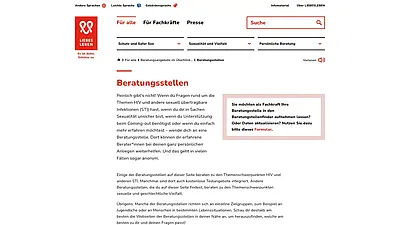
In Germany, you can find a list of testing options here:
Go to website -
-
In Germany, you can find a list of testing options here:
-
-
Anonymous notification of sexual partners
Go to website -

-
Anonymous notification of sexual partners
Talking about STIs, getting tested, and using protection does not make you “unsexy.” On the contrary, it shows that you are taking responsibility for yourself and for your partners.
Zeit zur Reflektion
And now?
You have learned a lot about STIs. Now think about it for yourself:
- Have you ever been tested?
- Should you get tested?
- Have you had all the important vaccinations or do you need to catch up?