Sex Work
Information, Perspectives, Support
What is sex work?
Sex work refers to the consensual, paid providing of sexual or sexualized services between consenting adults of legal age.
The term is used to describe services such as erotic massages, telephone or digital services, striptease, BDSM services, escort work, and classic sexual services such as penetrative or oral sex.
It is important to distinguish between non-consensual forms such as human trafficking, forced prostitution, or sexual exploitation. These must be clearly distinguished from voluntary sex work, both legally and ethically.
Sex work is part of our society and encompasses different realities of life. It is influenced by self-determination, labor rights, health, and social taboos. Sex work is a form of paid labor. At the same time, for many people, it is a sensitive topic that is burdened with stigma and prejudice.
Sex work encompasses all forms of sexual services offered in exchange for payment, such as:
Street sex work
Street sex work
Sexual services are provided in public places (such as streets, squares, or parks), or clients are solicited there. The actual services are then often performed in cars or nearby hotels. This form of sex work can entail risks in terms of safety and stigmatization. In many countries, this form of sex work is also prohibited or subject to special regulations. Sex workers who work in this way are exposed to different social and societal pressures than those who work indoors.
Indoor sex work
Indoor sex work
This takes place in protected, private, or commercial spaces. These include brothels, red-light districts, studios, private apartments, or hotels where services are offered. The acquisition of clients is often more discreet and better organized. Working conditions can be more standardized or safety-oriented.
Escort services
Escort services
Escort services are often described in German using the term “Begleitservice.” This involves accompanying clients in exchange for payment, for example to social occasions, events, or even for personal purposes. Depending on the agreement, these services may also include sexual services, but this is not necessarily the case. Escort work typically takes place by prior appointment and is more individualized and less visible to the public than street work.
In the public perception, escort work is often judged differently than street work, not least because of its discretion and sometimes higher compensation. However, academic discussions emphasize that these differences in social conditions do not automatically imply greater self-determination.
Online sex work
Online sex work
via platforms such as OnlyFans, chat services, or webcam services.
Studies show that the platforms themselves have a strong impact on the way the work is done. Those who are highly visible, “serve” the algorithm, and present themselves as a brand are more likely to earn money, but in return they have to be online virtually all the time, produce content, and write to fans.
Online sex work is therefore described in contradictory terms. It can offer more freedom, security, or anonymity than other forms of sex work, but it also brings with it new uncertainties. Workers are dependent on the rules of the platforms, and there is a risk that content will be shared without the worker's consent, leading to lasting stigmatization.
Surveys of users of online sex work show that a large proportion of them are male, although this varies depending on the platform and what is on offer. In addition to sexual arousal, emotional needs also play an important role for many, such as experiencing closeness, intimacy, validation, or a “girlfriend/boyfriend experience,” i.e., a contact similar to a relationship. Research on platforms such as OnlyFans also suggests that users not only consume pornography, but also seek instant messaging, personalized content, and longer-term connections to reduce loneliness, open up more easily, and improve their own sexual communication.
Pornography and erotic labor
Pornography and erotic labor
Pornography refers to the media representation of sexuality with the aim of eliciting sexual arousal. It can take various forms, such as video, images, text, or audio, and is distributed through various channels. While print media used to be common, the focus today is on digital platforms.
From a scientific point of view, pornography is not a uniform product but differs in regard to:
- production conditions
- bodies, practices, gender and societal roles that are depicted
- target groups
- ethical and legal frameworks
The use of pornography is not necessarily negative but depends heavily on the context of its use, age, gender, education, relationship experiences, and the level of prior educational exposure to sexuality.
Pornography and erotic work are often understood as sub-areas of sex work, but they differ in important ways:
- Physical contact with customers is usually absent or completely absent
- Legal frameworks differ depending on the country and platform
What both fields have in common is that they are heavily stigmatized. Studies show that this stigma often causes greater stress than the activity itself, for example through social exclusion, lack of legal protection, or difficulty accessing health care.
Sexual companionship and sexual assistance
Sexual companionship and sexual assistance
Professional sexual services for people with disabilities, chronic illnesses, or care needs, with a focus on participation, physical closeness, and personal autonomy.
Sexual assistance is a special area of sex work, as it is specifically aimed at people who have limited access to sexuality and physical intimacy. In addition to sexual satisfaction, it is primarily about intimacy, touch, and experiencing physicality. From a legal perspective, sexual companionship is a form of sex work, but it is ethically distinct from “classic” sex work because it is not “only” about sexuality as such and focuses on breaking down barriers to sexuality for people with disabilities.
Sex work is diverse and varies greatly depending on the place of work, motivation, and personal life situation. There is no such thing as “the one sex work,” but rather very different realities.
More on sex workers' understanding of their profession
-
-
Bundesverband Sexarbeit
to the website -
-
Bundesverband Sexarbeit
Language and terminology
You shouldn't say “prostitution” anymore.
It's true!
Language shapes how we think about issues. The term “prostitution” is often used in a derogatory manner and is closely linked to stigma, criminalization, and prejudice. Many sex workers therefore find it hurtful or demeaning. The term “sex work,” on the other hand, presents the activity as work, just like any other form of paid labor. It emphasizes self-determination and professionalism and puts the rights of sex workers at the forefront.
Social discourse and stigmatization
Sex work is paid work. Sex workers offer professional sexual services in exchange for payment. Cases of coercion, human trafficking or exploitation must be taken seriously, but they do not fall under the definition of sex work and are addressed separately.
Sex work is at the intersection of various social discourses:
Body, sexuality, and morality
Body, sexuality, and morality
In public and political debates, sex work is often treated not as a form of work, but as a moral problem. The assessment of sex work reflects social norms about who is allowed to express their sexuality, in what form, and under what conditions.
Bodies are judged according to gender, perceived attractiveness, or “purity,” and these attributions influence how sex work is discussed. Moral notions of “proper” sexuality also lead to sex workers being stigmatized or dehumanized, rather than their work being viewed as an expression of self-determination, economic reality, or a form of providing care.
A society's attitude toward sex work is therefore also a reflection of its attitude toward sexuality as a whole.
The role of gender
The role of gender
In some social ideologies, sexuality is still considered something that is primarily demanded by men and offered by women. This perspective stabilizes power structures. As a result, sex workers, especially women, are reduced to their “service role.” At the same time, sex workers who are not female, such as trans*, inter*, male, or non-binary persons, often remain invisible.
Gender hierarchies also influence working conditions. Protection, recognition, pay, and respect are often distributed according to gender-based attributions. Here, too, sex work reflects societal perceptions of who is controllable or capable of self-determination.
Men who engage in sex work are significantly less studied in research than women, which means that many experiences of men in sex work remain invisible and support services are patchy. Studies show that male sex workers often face specific forms of stigmatization, shame, or even double discrimination (e.g., because of their work and their sexual orientation). This can also lead to sex workers' mental health suffering and them not accessing help.
Male sex workers also report in studies that they do their job for economic reasons but also because of a need for sexual self-determination. At the same time, however, they also experience exploitation, violence, or expose themselves to health risks (e.g., through pressure to have unprotected sex). Their perspective therefore ranges from empowerment to vulnerability.
Men and sex work
Although male sex workers represent a smaller group, 26.9% of men in Germany have, at some point, paid for sex. Morally, this is less condemned in Germany than in neighboring countries. Men who have paid for sex have, on average, sex with about twice as many people as the average man. They typically pay for vaginal or oral sex with women and are more likely to do so under the influence of drugs or alcohol than during other sexual encounters.
Migration
Migration
Many sex workers have a migration background. This is often because other job opportunities are difficult to access, for example, due to a lack of language proficiency, a lack of recognition of their educational qualifications, or a precarious immigration status. As a result, these sex workers in particular are more likely to find themselves in situations where they are dependent on others or do not experience fair working conditions.
At the same time, they are often viewed with greater suspicion or automatically associated with exploitation, even though many of them are engaged in sex work of their own free will.
Looking at migration, it becomes clear that it is not the origin itself that is a risk, but rather the social and legal conditions that determine who has access to good working conditions and who does not.
Stigmatization based on these factors has tangible consequences: it hinders access to medical care and legal support and often leads to discrimination in everyday life.
Important: The voices of sex workers themselves need to be centered. They demand respect, safe working conditions, and recognition of their work.
Legal framework in Germany
Sex work is legal in Germany and has been regulated since 2002 by the Prostitution Act (Prostitutionsgesetz, ProstG) and since 2017 by the Prostitute Protection Act (Prostituiertenschutzgesetz, ProstSchG).
Key regulations:
- Registration requirement and regular health counseling for sex workers (§1-10)
- Licensing requirement for operators of brothels or clubs (§12-23)
- Requirement to pay tax on income from sex work (§7)
- Stricter official controls of brothels (§29)
- Condom requirement (§32)
Rights & protections:
Sex workers are entitled to protection, counseling, and medical care. This includes in particular:
More information is available from Madonna e.V., an association that supports sex workers in Bochum and the surrounding area and offers counseling and assistance.
The legal regulations are the subject of controversial debate. Some see them as protective measures, while others criticize the additional pressure and stigmatization caused by registration requirements, which have a significant impact on the autonomy of sex workers.
International perspectives
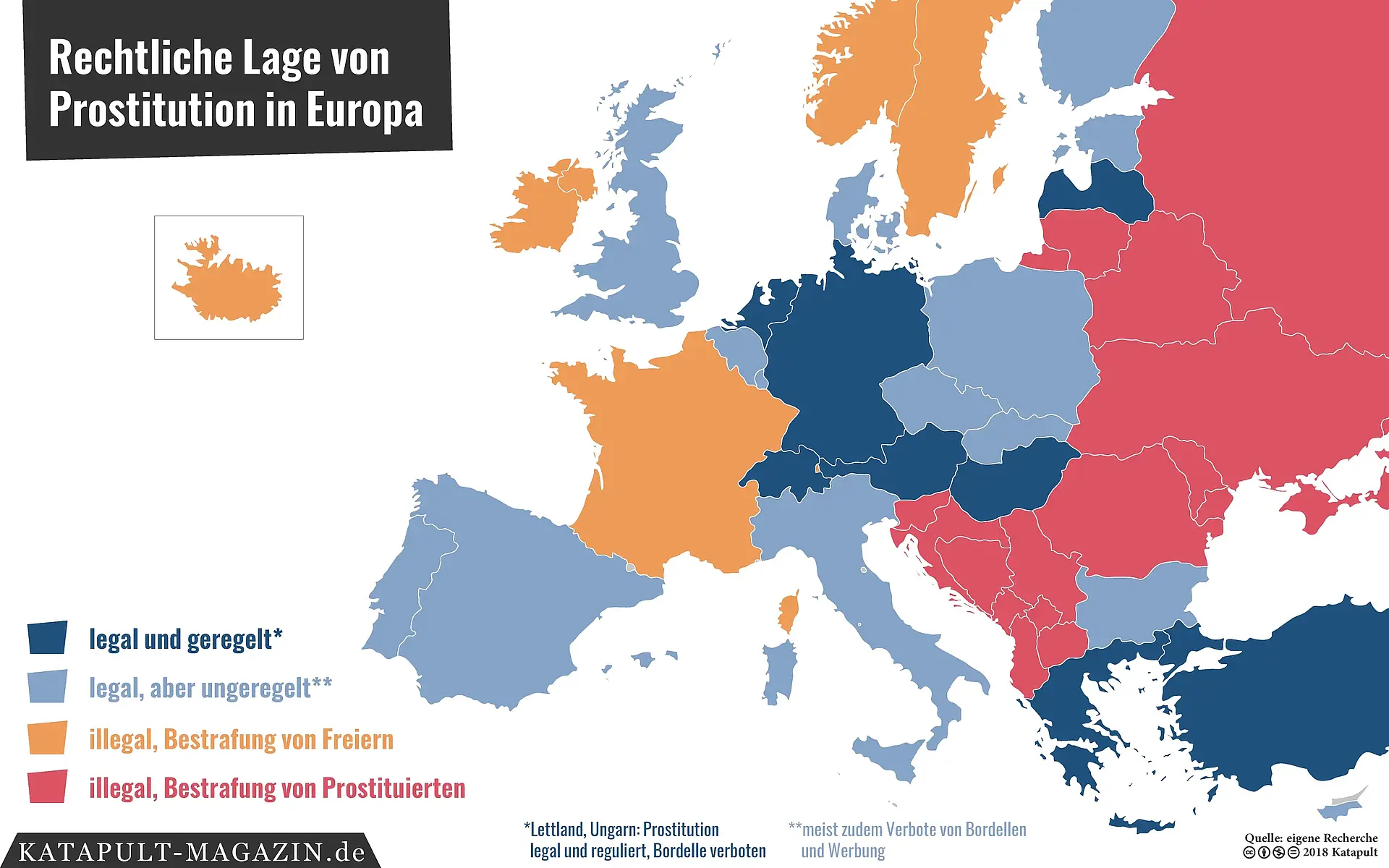
Sex work is regulated very differently around the world. In some countries, it is fully criminalized and is generally understood as violence against women and a threat to gender equality. Sex workers are viewed primarily as victims. Other countries follow the so-called “Nordic model,” in which it is not the providing of sexual services that is punishable, but rather the purchasing of them. The effectiveness of this and similar models is controversial. Then there are countries like Belgium, New Zealand, and parts of Australia that have opted for a model of legalization and decriminalization, actively involving sex workers in the drafting of regulations..
Source: KATAPULT magazine 2018
Banning the purchase of sex and the Nordic model
Banning the purchase of sex and the Nordic model
The so-called Nordic model (also known as “Sexkaufverbot” or “end demand” model) was first implemented in Scandinavian and Nordic countries and does not criminalize sex workers themselves, but rather the purchase of sexual services. The aim is to reduce sex work in society and get people out of prostitution.
Advantages that are often mentioned:
- People who offer sex as a service should not be prosecuted
- The model is intended to deter customers and thereby reduce exploitation
- It sends a social signal that sex should not be for sale
Disadvantages that are apparent in practice:
- Fewer clients often leads to greater dependency and poorer conditions for sex workers (e.g., less choice, shorter negotiations).
- Work increasingly takes place in secret, which makes safety and security more difficult.
- Contact with support services becomes less frequent because clients and, in some cases, sex workers are afraid of inspections.
- Sex workers report more pressure to offer riskier practices in order not to lose clients.
Studies show:
Where sex work is criminalized, the risk of violence, discrimination, and health problems can increase for sex workers, especially for migrant sex workers.
Counseling & Support
Sex work is a complex issue. It is important to take a nuanced view that highlights the diversity of real-life circumstances and, above all, focuses on the rights, health, and safety of sex workers.
If you have any questions or need support—whether you are entering or leaving the industry, or have health, legal, or social issues—Madonna e.V. in Bochum offers confidential, free, and multilingual counseling.
You can find an overview of nationwide counseling centers here.
There are also counseling centers that specifically target men in sex work. For example, neonlicht in Dortmund.